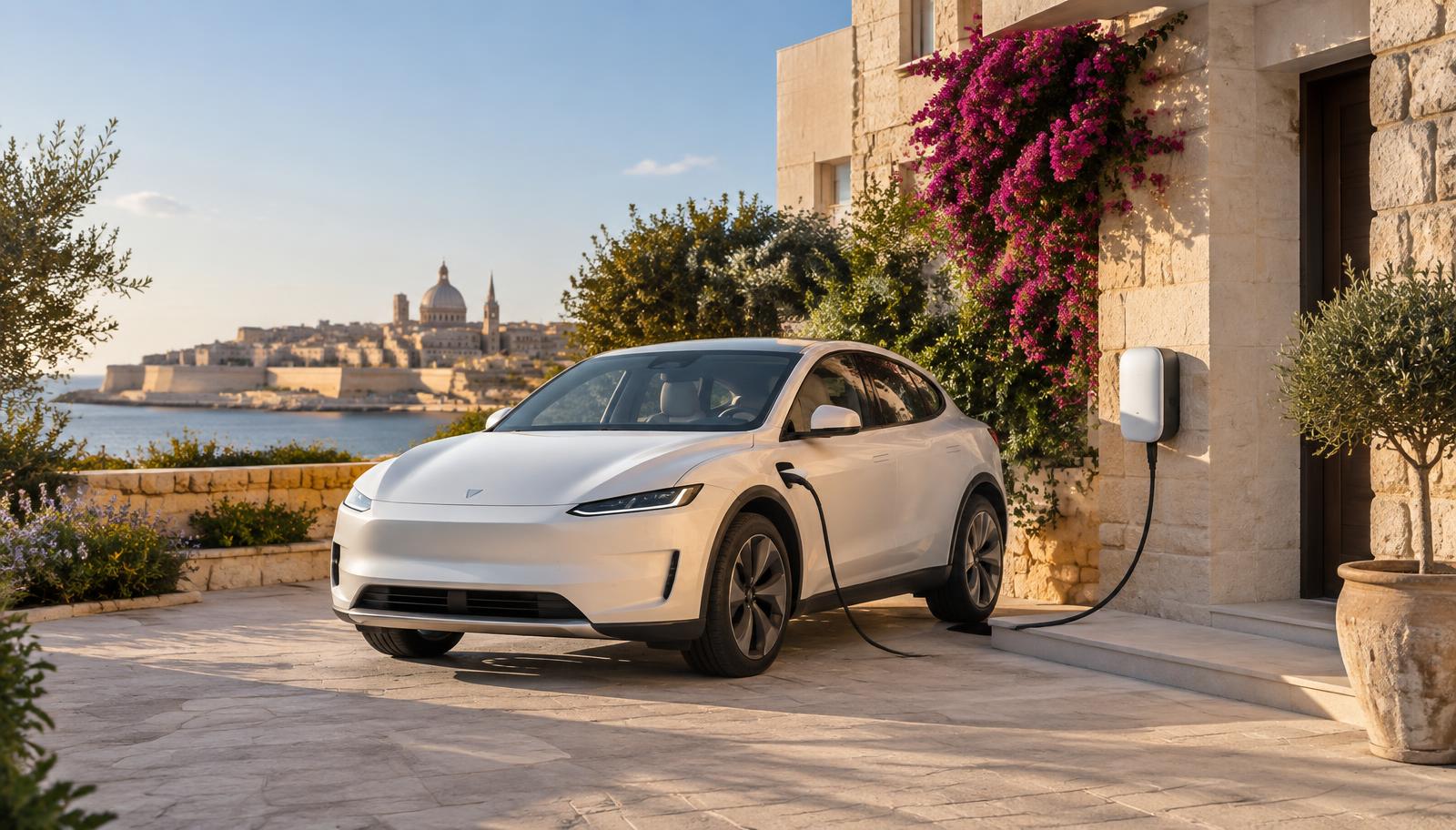
Charging an EV at home in Malta can cost surprisingly little — and far less than filling a combustion-engine car with petrol or diesel.
The exact cost depends on the size of the battery, which electricity tariff you are on, and whether you have a dedicated EV meter.
First: Malta has a dedicated EV tariff
If you install a dedicated EV meter, you can charge at a special off-peak EV rate of €0.1298/kWh.
That rate applies:
- 00:00–05:59
- 12:00–15:59
- all day Sunday
The EV meter currently costs €50 to install for single phase or €80 for three phase, plus a monthly service charge of €4 or €6 respectively. Full details are on the REWS electricity page.
If you don’t have a dedicated EV meter, charging becomes part of your normal household electricity consumption.
What if I just charge from my normal residential supply?
Malta’s residential tariff increases as annual consumption rises:
| Annual consumption | Residential rate |
|---|---|
| 0–2,000 kWh | €0.1047/kWh |
| 2,001–6,000 kWh | €0.1298/kWh |
| 6,001–10,000 kWh | €0.1607/kWh |
| 10,001–20,000 kWh | €0.3420/kWh |
| Over 20,000 kWh | €0.6076/kWh |
So EV charging may be relatively cheap if your household remains in the lower bands, but it can become much more expensive if the extra electricity pushes you into the higher bands.
How big is an EV battery?
Most mainstream EVs are somewhere around 40–70 kWh, although smaller city EVs can be around 30 kWh and larger premium models can exceed 80–100 kWh.
Some real examples:
| EV | Battery | Approx. range |
|---|---|---|
| BYD Dolphin Surf | 30 or 43.2 kWh | 220–322 km WLTP |
| Toyota Urban Cruiser | 49 or 61 kWh | 344–426 km WLTP |
| MG4 | 51 or 64 kWh | Varies by version |
| BYD Dolphin | 60 kWh | Up to 427 km WLTP |
Battery size and driving range are related, but not identical — efficiency also matters. Figures for the Toyota come from Toyota’s own newsroom, and the BYD figures from BYD Europe.
What does a full charge actually cost?
Take a typical 60 kWh EV.
| Charging tariff | Approx. cost from 0–100% |
|---|---|
| Residential Band 1 | €6.28 |
| EV off-peak tariff | €7.79 |
| Residential Band 2 | €7.79 |
| Residential Band 3 | €9.64 |
| Residential Band 4 | €20.52 |
| Residential Band 5 | €36.46 |
In reality, most owners don’t routinely charge from completely empty to completely full. If you come home with 50% remaining and add 30 kWh, charging at the off-peak EV rate costs about €3.89.
What about public charging?
Public charging can be faster, but not necessarily. Malta’s Charge My Ride network currently lists medium chargers at €0.1698/kWh off peak and fast chargers at €0.1798/kWh off peak, with slightly higher peak rates.
For a 60 kWh full charge, that works out at roughly:
- €10.19 on a medium public charger off peak
- €10.79 on a fast charger off peak
So public charging generally costs more than the dedicated home EV tariff.
Will a public charger charge my car faster?
Potentially — but the charger is only half the story.
A home charger normally uses AC power. Public networks can offer faster AC charging and, in some locations, DC fast charging.
Your car has its own maximum charging rate, though. A car that can only accept 85 kW cannot suddenly charge at 150 kW simply because you plug it into a 150 kW charger. For example, Toyota says the Urban Cruiser can recharge from 10% to 80% in around 45 minutes using DC fast charging.
The takeaway
For most EV owners in Malta, home charging with a dedicated EV meter during off-peak hours will usually be the simplest and most predictable option.
A typical 50–60 kWh EV costs around €6.50–€7.80 to charge from empty at the dedicated off-peak rate.
If you charge through your normal household meter instead, the cost depends heavily on which residential tariff band that additional electricity falls into.
And if you need a quick top-up away from home, public fast charging is useful — but generally costs a little more.