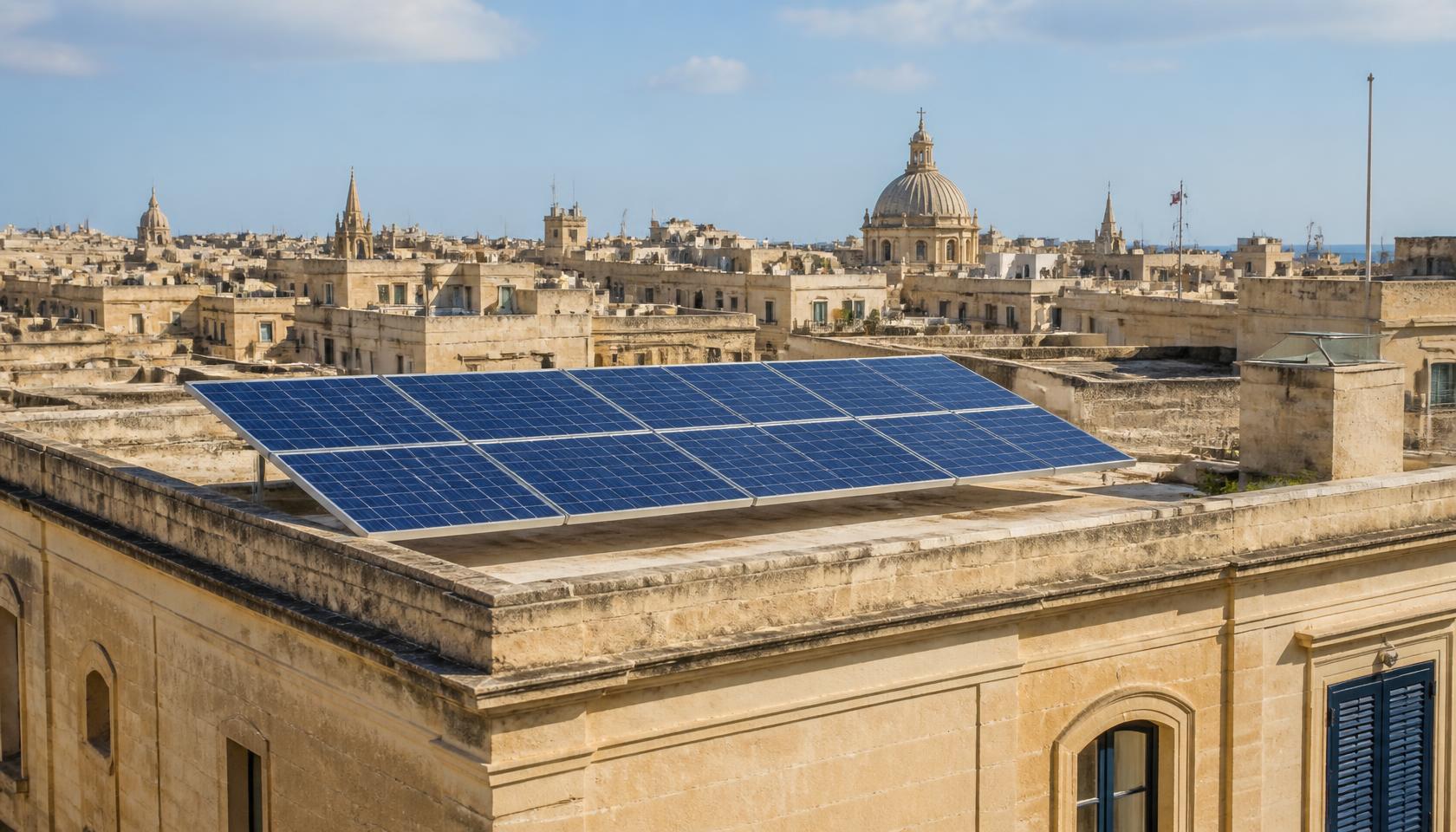
For many homes in Malta, yes — solar panels can still be a very good investment.
We have plenty of sunshine, household electricity use is relatively high, and government support can significantly reduce the upfront cost.
But whether solar makes sense for your home comes down to three things:
How much electricity you use, how good your roof is, and how much the system costs.
How much electricity does a typical home in Malta use?
A useful starting point is around 4,500 kWh per year.
The Energy & Water Agency estimated average Maltese household electricity consumption at 4,473 kWh per year, based on 2022 residential electricity consumption.
Consumption varies significantly between homes.
As a rough guide:
| Household | Approx. electricity use |
|---|---|
| Small / efficient apartment | 2,500–3,500 kWh/year |
| Average Maltese household | ~4,500 kWh/year |
| Larger family home | 5,500–7,000+ kWh/year |
| Heavy AC, pool, EV or other large loads | 8,000+ kWh/year |
The 4,500 kWh figure is an official average; the other ranges are simply useful examples.
Property type also matters. Malta's Long-Term Renovation Strategy found average modelled energy use of around 3,734 kWh/year for apartments and other multi-family homes, compared with 5,690 kWh/year for single-family houses. Those figures exclude normal appliances, so they aren't directly comparable with meter readings, but they show how much property type can affect demand.
And unsurprisingly, summer matters. Average household electricity use reached around 16.5 kWh per day in July and August, compared with roughly 9–10 kWh/day in some cooler months. Air conditioning is a big part of the Malta energy story.
How much can solar generate?
Solar systems are normally sized in kWp.
For example, ten 450 W panels give you a 4.5 kWp system.
The actual electricity generated depends on your roof, including:
- orientation
- shading
- available space
- panel angle
- equipment and system losses
Malta has an excellent solar resource, so a well-designed system can generate a substantial proportion of a typical home's annual electricity needs.
But we shouldn't tell everyone that they need the same size system. That's where the roof and your actual consumption need to be considered together.
What happens to the electricity?
With a typical partial-export system, the electricity generated by your panels is first available to your home.
So if the panels are generating while your AC, pool pump or appliances are running, you can use that solar electricity instead of importing electricity from the grid.
If you generate more than you're using, the surplus can be exported to the grid and paid according to the applicable Feed-in Tariff.
So you potentially benefit in two ways:
- Use solar yourself → buy less electricity from the grid
- Export the excess → receive payment for it
What government support is available?
Under Malta's current 2026 Renewable Energy Sources Scheme, an eligible PV system with a hybrid inverter can receive:
65% of eligible costs, capped at €3,000 per system and €645 per kWp.
So, for example:
- System price: €7,000
- Grant: €3,000
- Cost after grant: €4,000
The grant can therefore make a significant difference to the payback.
Importantly, taking the grant does not mean your excess electricity becomes worthless.
REWS rules allow grant-supported systems to receive an applicable Feed-in Tariff. Where grant support exceeds 50%, the tariff is reduced according to the level of grant received.
There is also a separate €0.15/kWh Feed-in Tariff for 20 years available in 2026 for qualifying PV installations of 1 kWp to under 40 kWp that receive no capital grant or other investment support.
So there are effectively two routes worth comparing:
- Take the grant → lower upfront cost + applicable reduced FIT
- No grant → higher upfront cost + €0.15/kWh FIT
Which works better depends on your individual system and expected exports.
So, is solar worth it?
Solar is particularly worth looking at if:
- you own the property
- you have a suitable unshaded roof
- you use around 4,000 kWh/year or more
- you use plenty of electricity during the day
- you have significant AC or pool usage
- you can get a competitive installation price
It can be less attractive if your roof is heavily shaded, usable roof space is very limited, your electricity consumption is low, or the installation quote is simply too expensive.
The bottom line
For a typical Maltese household using around 4,500 kWh of electricity per year, solar is absolutely worth investigating.
But don't start by asking:
“How many panels can I fit?”
Start with:
“How much electricity do I use, what can my roof produce, and what gives me the best financial return?”
That's exactly what our Solar Calculator is designed to work out.
Check your solar potential
Use our Malta-specific Solar Calculator to estimate your roof's generation, your savings, and the payback after the 2026 grant.