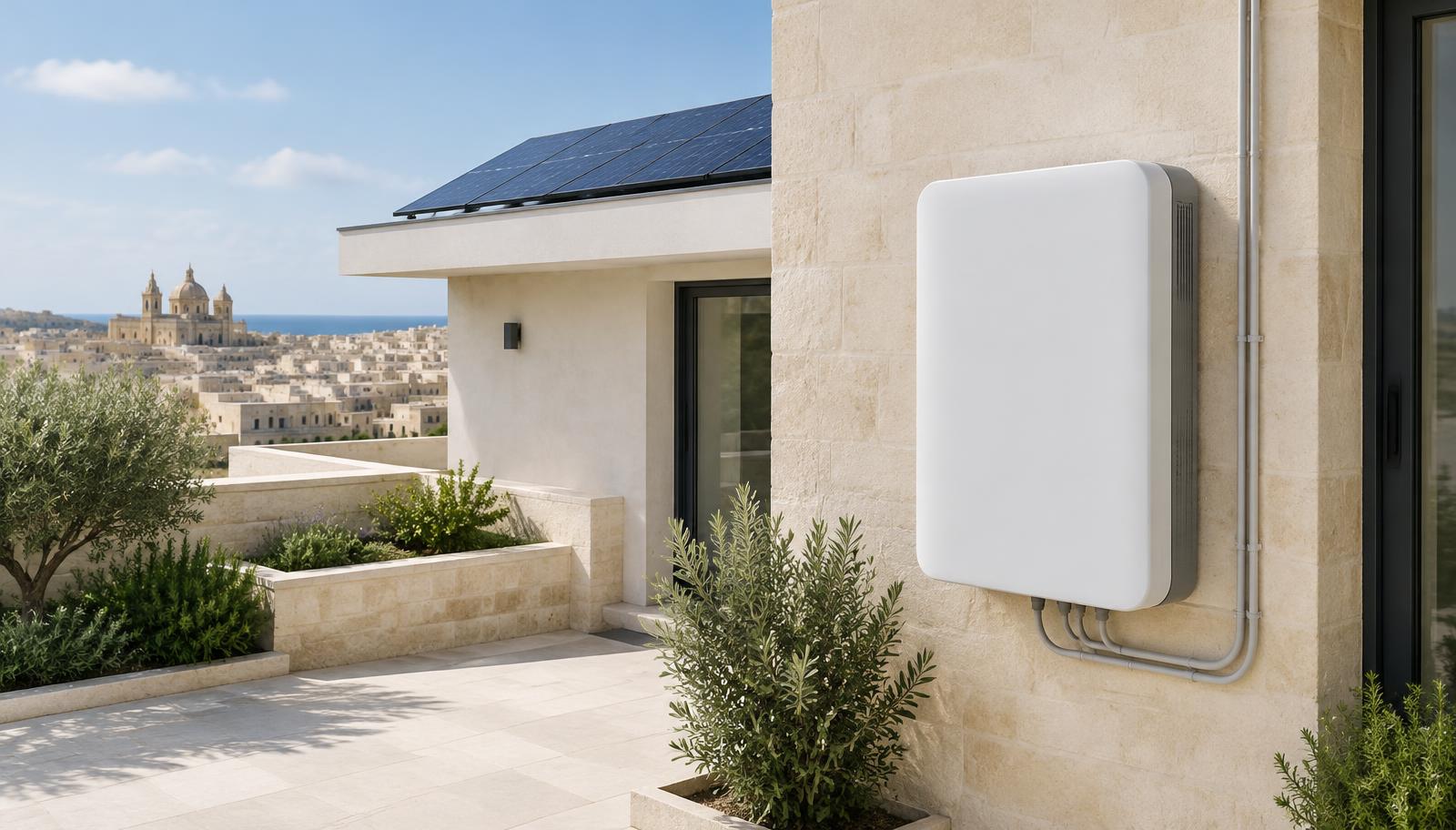
Illustrative image of an unbranded home battery in a Maltese solar-home setting; not a photograph of Tesla Powerwall 3.
Tesla’s Powerwall is probably the best-known home battery in the world, and the latest Powerwall 3 is one of the more capable residential batteries now available in Malta. It combines a 13.5 kWh usable battery, an integrated inverter, backup capability and Tesla’s energy-management software in one system.
That makes it technically impressive, but it doesn’t automatically make it the right battery for every Maltese home. The real question is whether your household can make enough use of 13.5 kWh of storage, and of Powerwall’s relatively high power output, to justify choosing it over a smaller or simpler alternative.
At a glance
| Specification | Powerwall 3 |
|---|---|
| Usable capacity | 13.5 kWh |
| Power output | Up to 11.04 kW |
| Backup power | Yes, when correctly configured |
| Integrated solar inverter | Yes |
| Warranty | 10 years |
| Expandable | Yes |
| Best suited to | Medium-to-large solar homes, higher loads and households wanting backup |
| Energy Wise Malta score | 8.5/10 |
Storage capacity
At 13.5 kWh, Powerwall 3 offers a meaningful amount of storage for a residential system. For a household with a reasonably large PV installation and significant evening consumption, that gives you plenty of scope to capture daytime solar generation and use it later rather than exporting it immediately.
The important point, though, is that bigger isn’t always better. If your system normally produces only 3–4 kWh of surplus solar each day, a 13.5 kWh battery could spend much of its life partly empty. Likewise, a household with low evening consumption may simply not cycle enough energy through the battery to justify buying this much capacity.
That is why we would always start with your own consumption and solar-export profile rather than selecting a battery based on brand or headline capacity. Use our Battery Size Calculator to estimate a sensible starting range for your home, or read our guide to choosing a home battery size in Malta.
Power output and backup
One of Powerwall 3’s biggest strengths is not just how much energy it stores, but how quickly it can supply it. Tesla specifies up to 11.04 kW of on-grid and backup power, depending on local system conditions.
That distinction matters. Battery capacity tells you how much energy is available; power output tells you how many appliances you can run at the same time. For homes with multiple air conditioners, electric cooking, pumps, EV charging or other significant loads, Powerwall’s higher output can therefore be genuinely useful.
Backup is another major attraction. With the appropriate Tesla Backup Gateway and installation configuration, Powerwall can disconnect the home safely from the grid during an outage and continue powering selected household loads.
How long it lasts depends entirely on consumption. A lightly loaded home may run for many hours, while several air conditioners, cooking appliances and other high-power loads will drain the battery much more quickly. Try the backup options in our Battery Size Calculator to estimate the storage needed for the loads and duration you have in mind.
Software and usability
Tesla’s software is one of the strongest parts of the package. Through the Tesla app, users can monitor solar generation, household consumption, battery charge, grid imports and exports, and backup reserve in one place.
For homeowners who actually want to understand how their system is operating rather than simply having a battery fitted and forgetting about it, this is a meaningful advantage. Powerwall also receives remote software updates, so the system can continue to evolve after installation.
Expandability
Powerwall 3 can also be expanded if your energy needs change. That can be useful if you later add more solar panels, buy an EV, increase air-conditioning use or decide that you want more backup capacity. For some buyers, that flexibility will be more valuable than simply choosing the cheapest battery available today.
Where Powerwall 3 is less convincing
The biggest issue is that Powerwall may simply be more battery than some Maltese households need. A smaller apartment, an efficient household or a property with relatively little daytime solar surplus could achieve much the same practical benefit from a smaller system.
There is also a broader financial question. A battery does not create electricity; it shifts electricity from one part of the day to another. If you are currently receiving a reasonable payment for exported solar, the economic benefit of storing that electricity instead can be relatively modest. If your export value is low and you subsequently import significant amounts of electricity in the evening, the case becomes stronger.
Our guide to whether a home battery actually saves you money in Malta explains that trade-off. The Solar Calculator can also help you put your household’s solar generation and electricity use into context.
Malta battery grant
Grant support can materially change the economics of a home battery. Under Malta’s 2026 RES scheme, qualifying battery storage installed with new PV could receive 75% of eligible battery costs, subject to a maximum of €600 per kWh and €6,000 per system.
However, the 2026 call is now closed to new applications, and future schemes may have different eligibility rules, caps or funding levels. For that reason, we would not recommend choosing a battery on the assumption that a particular grant will still be available. Check the current scheme before ordering or committing to an installation.
See our Battery Grants in Malta 2026 guide for the scheme’s conditions, and confirm any current support directly with REWS.
Who installs Tesla Powerwall in Malta?
Tesla recommends using a Tesla Certified Installer for Powerwall installations. Bajada New Energy has publicly announced that it is an authorised Tesla Powerwall installer in Malta, while ISD also offers Tesla Powerwall systems locally. Installer status can change, however, and there may be other certified installers serving Malta.
Energy Wise Malta has no commercial relationship or affiliation with Tesla, Bajada New Energy, ISD or any other installer mentioned in this review. We receive no payment for including them.
Compare the complete installed system, including backup capability, Backup Gateway, electrical works, commissioning, warranty support and grant-related documentation where applicable. Use Tesla’s Certified Installer finder and confirm the proposed configuration before committing.
Who is Powerwall 3 best suited to?
| Household or priority | Our assessment |
|---|---|
| Larger home with solar | Strong fit, particularly where there is meaningful daytime surplus and evening consumption |
| Home where backup matters | One of Powerwall’s strongest use cases |
| High electrical loads | Well suited to homes with air conditioning, pools, electric cooking or EV charging |
| Tech-focused homeowner | Tesla’s app and monitoring are a major strength |
| Small apartment or low-consumption household | May be more storage than you need |
| Home with limited solar surplus | Battery may not cycle enough to justify the capacity |
| Buyer focused purely on fastest payback | A smaller or lower-cost battery may offer better economics |
Energy Wise Malta verdict
Powerwall 3 is an excellent residential battery. Its combination of 13.5 kWh of storage, high power output, backup capability, an integrated inverter and strong software makes it one of the more complete systems available. Its main weakness is also fairly simple: not every Maltese household needs 13.5 kWh of storage.
For larger homes, households with significant solar generation, people who value backup power and users with higher electrical loads, Powerwall 3 is easy to recommend as a product worth considering. For smaller or lower-consumption households, a simpler and smaller battery may make more financial sense.
Score breakdown
| Category | Score |
|---|---|
| Battery capacity | 9/10 |
| Power output | 10/10 |
| Backup capability | 9/10 |
| Software & monitoring | 10/10 |
| Warranty | 8/10 |
| Value for money | 7/10 |
| Overall | 8.5/10 |
Value for money depends on your installed quotation, household consumption, solar exports and any grant support available at the time.
The key question isn’t whether Powerwall 3 is a good battery. It is. The question is whether 13.5 kWh is the right battery for your home.
Find a sensible starting point for your household with our Malta Battery Size Calculator.
Important information / disclaimer
This review is provided for general informational purposes and reflects Energy Wise Malta’s independent assessment of the product. Energy Wise Malta is not affiliated with Tesla or any installer mentioned in this article and has not received payment for this review.
Battery performance, compatibility, specifications, installer availability, warranties, grants and regulatory requirements can change. Actual performance will also depend on your property, electricity consumption, solar generation, installation design and how the system is configured.
Always confirm current product specifications with the manufacturer, current grant conditions with REWS and installation requirements with a suitably qualified installer before making a purchase decision.